Company · consumer-digital
Jwaala
A credit union-backed software venture that licensed its source code to customers and anticipated a cooperative model the sector would adopt a decade later.
Founded October 2, 2006 · Acquired November 2017
Active peak: 2008–2016
Austin, Texas, USA
Overview
Jwaala was a digital banking software company serving U.S. credit unions, founded in Austin in 2006 by two technology entrepreneurs and a software architect, and converted within months into a credit union service organization (CUSO) part-owned by Amplify Federal Credit Union. Amplify, formerly IBM Texas Employees Federal Credit Union, was also its first production customer. It operated for roughly eleven years as a privately held company, and was acquired by Alogent, a Georgia-based banking software firm, in November 2017. The Jwaala name and brand were retired and the platform was relaunched as Alogent Digital. At its peak, more than 120 financial institutions reportedly used Jwaala's consumer-facing products.
Founding
According to its own website, Jwaala had three founders. Rahul Shukla and Marty Saxton worked on security projects related to online banking. Andrew Taylor spent eight years at IBM writing software on the marketing side, then ran his own enterprise security business from 2003 with financial institutions among its clients. Taylor told Credit Union Times in June 2008 that his personal motive for co-founding Jwaala was the online banking experience at the time (2006) amounted to little more than a statement refreshed daily, which drove him mad.
An important breakthrough development for the nascent start-up was interest from Amplify. Taylor and Shukla were shopping the concept of a personal finance management (PFM) tool to institutions that complemented, but did not replace, online banking. In late 2006 when they visited Amplify Federal Credit Union, the CU was interested in taking a direct investment, shaping product direction, and launching as the first customer of the solution that would become 'MoneyTracker'. Taylor noted in trade press Jwaala then converted to become a Credit Union Service Organization (CUSO) to take a direct equity investment from Amplify once they made their strong interest clear.
Early Success
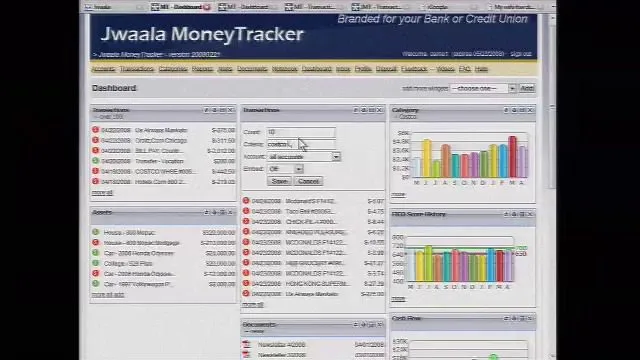
Amplify went live with MoneyTracker on March 5, 2007. Reviewing it that June, Online Banking Report's Jim Bruene noted the product's natural-language search and per-member RSS feeds for account activity set the solution apart. At the time, many financial institutions were feeling threatened by disintermediating third-party PFM solutions like Mint, Buxfer, and Wesabe, which eroded brand experiences and promoted competing loan and deposit products at unrelated institutions through their user interfaces. Jwaala offered a compelling way for institutions to bring PFM tools to their consumers without needing a fully-featured online banking replacement. MoneyTracker fit a small, credit-union focused niche with few alternatives for its use case.
Shukla left in 2007 after roughly a year as CEO, for BMC Software. Saxton left in February 2007 after seven months, for 2Wire. The gap left by those departures was filled by Kelly Dowell, who joined in 2007 and stayed until the acquisition. Dowell had owned an IT consulting firm calling on credit unions before founding CUISPA, the Credit Union Information Security Professionals Association, around 2005 — and he continued to run it throughout his decade at Jwaala. Taylor stayed on eleven years, through its eventual acquisition, and became the face of the company at industry events and in trade press. At FinovateStartup in April 2008, Jwaala was one of four solutions to win the 'Best of Show' award for best live demos. In December, it won the CUNA Technology Council's Best of Show at the BAI Retail Delivery Conference in Orlando.
Technology and Market Friction
The initial version of MoneyTracker was built on Linux, Apache, MySQL, and Ruby on Rails. This technology stack lends itself to fast prototyping, but is foreign to the target addressable credit union market that Jwaala sought to penetrate. Taylor admitted in a Microsoft-published case study in March 2010 that its customers behaved 'as if we were placing a spaceship in their IT center', since in this era, cloud computing was not embraced by most financial institutions, and solutions were typically colocated in client datacenters. In early 2008, the company spent four months rewriting the whole product in a pre-release version of ASP.NET MVC and migrated its client base off open source onto Microsoft. The migrations sapped resources, running all the way to the end of 2010 for live clients. The cost is visible in the client counts. Jwaala reported thirty-four credit unions in late 2009 and roughly thirty-five a year later — no net growth across the migration window — before reaching a hundred by 2015 and more than a hundred and twenty by 2016. The rewrite cost about a year of commercial momentum and then enabled the company's largest growth phase.
While Jwaala was winning mindshare with its FI-controlled PFM approach, boutique digital banking companies, like Q2, were also bolstering their flagship consumer banking user experiences with PFM functionality. Moreover, MoneyTracker's overlay architecture was at the mercy of incumbents: it lived inside host platforms Jwaala did not own, wrapped in headers and footers supplied by the vendor whose interface it occupied, and its viability depended on companies with every commercial incentive to control that experience themselves. In response, Jwaala attempted to expand MoneyTracker into a full-fledged online banking platform, first with a rebrand in 2009 to Better Online Banking (or B.O.B.) that touted expanded desktop online banking. By 2015, it had developed mobile applications as part of a unified online banking experience it called the Ignite Platform.
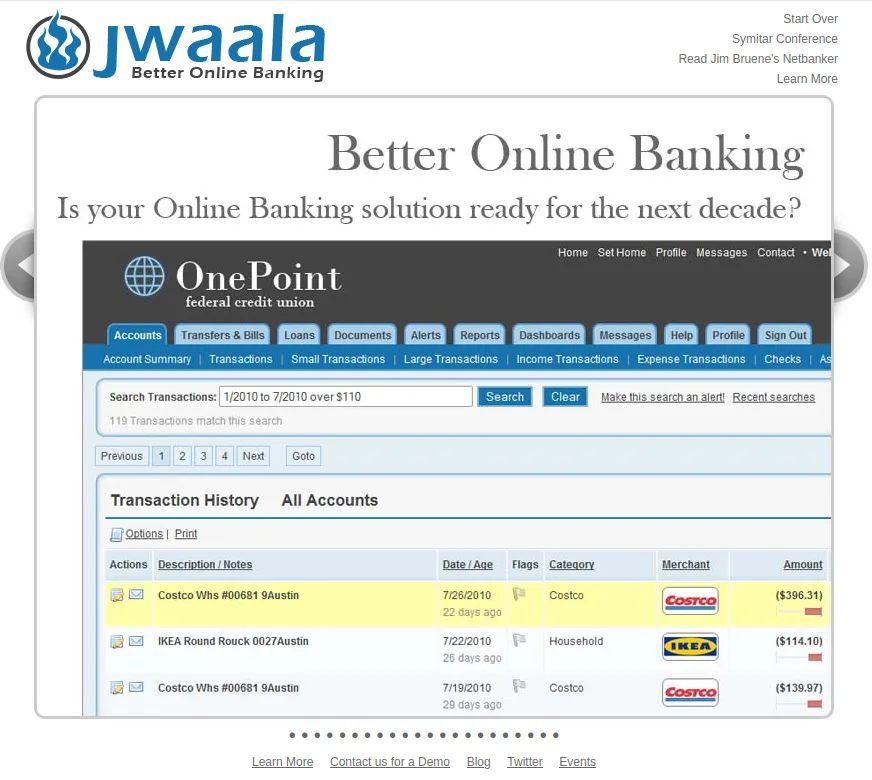
Jwaala did see some success in attracting interest in its vision for consumer banking digital experiences that put thoughtful, personal finance management functionality into individual consumers' web browsers. Among its relatively small-sized client base, by assets, it garnered interest and deals from some heavyweights too: United Nations FCU and Alaska USA FCU both signed on for Ignite, each institution over $5 billion in assets at the time. However, Jwaala never announced a funding round, and its openness carried a cost. By 2010 roughly a quarter of its customers had licensed the source code outright (all of them Windows and .NET shops with developers of their own) and were extending the platform themselves rather than buying more of it. Among credit union technology staff who worked with it, the platform acquired a reputation for difficult configuration: customizations were hard to carry across version upgrades, and the flexibility that attracted institutions with their own developers became a support burden the company absorbed.
Finale
Battery Ventures, a growth-equity firm, began to cobble together point solutions in 2016, starting with Bluepoint Solutions and Goldleaf Enterprise Payments, the latter of which it carved out of Jack Henry & Associates and renamed Alogent. Following this, it purchased Jwaala in 2017, then the FinanceGenius lending suite from IntelliEngines in 2019, rebranded Origins. On paper, combining payments rails, a digital channel and loan origination was a coherent portfolio play. In practice the digital banking line never led its market. Alogent kept selling the line — to Area Financial Services in 2020, Clearwater Credit Union in 2022, and Michigan First in 2024. But Jwaala's code was already gone by then. Taylor stayed on as a VP and digital banking segment specialist for fourteen months after the acquisition, leaving in December 2018. In November 2025, Alogent announced a partnership with the Portuguese vendor ebankIT under which ebankIT supplies the digital banking platform and Alogent contributes remote deposit capture and item processing. If anything of Jwaala survived the port, it is the least glamorous part. The core banking connectors — Symitar, UltraData, Phoenix, XP Systems, Open Solutions — represented years of protocol-level work against systems that change slowly, and are the one component nobody rewrites who can port it instead. Jwaala won its awards for the interface. It was probably outlived by its plumbing.
Jwaala's source code may not endure, but two of its ideas did. The first was commercial: roughly a quarter of its customers licensed the source outright and built on it with their own developers — a practice close to heretical among core-adjacent vendors in 2009, and unremarkable now in an industry that sells SDKs and open APIs as standard. Alogent's current marketing for NXT describes an open, API-based platform with an SDK for customization and personalized campaigns driven by user behavior data and predictive analytics: very nearly what Jwaala's founding whitepaper proposed in 2006, down to the transaction-triggered offers it then compared to Google AdWords.
The second idea was structural: Jwaala was a credit union's attempt to own its digital banking vendor rather than rent one. However, just a few years later, Amplify divested itself. It is often difficult for non-profit credit unions to effectively guide or operate for-profit enterprises, especially when they are both an investor and a customer. However, successive ventures eventually proved the model can work: In February 2014, CO-OP Financial Services, then one of the country's largest credit union service organizations, took a stake and a board seat in Alkami Technology. In April 2018, PSCU, the largest payments CUSO, went further and founded Lumin Digital outright, backing it with tens of millions in follow-on capital. Alkami went public in 2021 above a $3 billion valuation. In January 2024 the two CUSOs combined, rebranding as Velera and carrying both bets on one balance sheet.
Amplify Federal Credit Union got there first, in 2006, with $387 million in assets and three founders. What Jwaala lacked was not the idea but the capital base to fund it: one credit union's equity against, eventually, a sector's. While MoneyTracker is long since gone, the argument Jwaala made — that financial institutions should own their members' digital experience rather than cede it to someone else — is now simply how the industry works.
Milestones
-
Jwaala incorporated in Austin, Texas by co-founders Rahul Shukla, Andrew Taylor and Marty Saxton.
-
Amplify Federal Credit Union is the first FI to go live with Jwaala MoneyTracker. One of the earliest institution-controlled personal finance management deployments in the United States, offering natural-language transaction search and per-member RSS feeds of account activity.
-
Rewrites the entire product from Ruby on Rails to ASP.NET MVC, migrating its client base off Linux, Apache and MySQL onto a Microsoft stack more familiar to financial institutions.
-
Wins Best of Show at FinovateStartup 2008, one of four winners alongside First ROI, Zecco and Zopa.
-
Launches MoneyTracker BOB (Better Online Banking), moving from a PFM module to a competitive online banking platform. The architectural turning point. MoneyTracker had been an overlay embedded inside an institution's existing online banking, delivered with customizable headers and footers supplied by the host vendor. BOB replaced the online banking platform itself and absorbed PFM into it. By 2010 Taylor was declining the PFM label in interviews, and the product line continued through Better Mobile Banking to the unified Ignite platform around 2015.
-
The CUSO relationship with Amplify Federal Credit Union ends; trade press describes Jwaala as a former CUSO.
-
Acquired by Alogent for an undisclosed sum. The Jwaala name is retired and the platform relaunched as Alogent Digital. Ends eleven years of independence. Alogent had itself been assembled by Battery Ventures in 2016 from Bluepoint Solutions and the deposit-automation business Jack Henry held as Goldleaf Enterprise Payments. Alogent later moved to a successor platform, NXT, which it describes as built from the ground up, and in November 2025 announced a partnership under which an external vendor supplies its digital banking layer.
Sources
- "New Association Focusing on Credit Union Security Debuts in Reno", Credit Union Times, 21 October 2003. The founding of CUISPA, later run concurrently by Jwaala's head of business development.
- "Intrusion Inc. Joins CUISPA Membership; Compliance Partnership to Kick-off with National Credit Union WebEx in March", Business Wire, 22 February 2005. Establishes CUISPA's charter affiliate program, its vendor membership, and Kelly Dowell as executive director.
- "CUISPA IT Risk Management Summit Draws Rave Reviews; Everything From Phishing to Malware Covered", Credit Union Times, 7 February 2006. Roughly 115 credit union IT professionals and 30 security vendors at the Driskill Hotel, Austin; gives Dowell's prior background. — "the organization was the brainchild of Dowell, who previously owned an IT consulting firm"
- Jwaala, "The next generation of Online Banking services", company whitepaper, 8pp., c. late 2006. Internet Archive capture of 21 February 2007. The founding market thesis; UI screenshots timestamped 11 September 2006. Internally inconsistent on the U.S. online banking population, giving 50M, 60M and 63M in separate passages. — "very subtle context sensitive messages to consumers (like Google Adwords)"
- Jwaala, "Company Overview", jwaala.com, copyright 2006. Internet Archive capture of 19 February 2007. Names the three founders and lists Amplify FCU among the company's principals. — "a strategic partnership between an innovative financial institution and two entrepreneurs"
- Jim Bruene, "Amplify Credit Union MoneyTracker with Personal RSS Feeds Named OBR Best of the Web", Online Banking Report / NetBanker, 11 June 2007. Best of the Web award for 2007; records Amplify as the first installation without noting it was also a part owner. — "is Jwaala's first installation"
- FinovateFall 2007 presenter profile, Jwaala. Charter Finovate conference; Andrew Taylor demonstrating as CTO. Earliest conference self-description.
- "CUISPA Warns of 450 Possible Threats of Typosquatting", Credit Union Journal / American Banker. Dowell quoted as CUISPA executive director during his Jwaala tenure.
- FinovateStartup 2008 presenter profile, Jwaala. Best of Show; states the competitive thesis against consumer PFM and gives 11 financial institution clients from $150M to $9B in assets. — "disintermediate financial institutions and often recommend competing sources of financing"
- "Best of Show Award Winners Since 2007", Finovate. Confirms Jwaala among four FinovateStartup 2008 winners, with First ROI, Zecco and Zopa.
- Marc Rapport, "Jwaala Claims Its Spot As Passionate Online Personal Finance Manager", Credit Union Times, 10 June 2008. The most substantive single source: Taylor's background, the CUSO conversion sequence, the name etymology, pricing of $12,000 to the upper $20,000s per year, the integration surface, and the Texas Trust / Air Force FCU Symitar MemberConnect integration. — "We didn't start out as a CUSO."
- jwaala.com homepage, Internet Archive capture of 23 July 2008. Carries a testimonial attributed to "Kelly Dowell (CUISPA)" with no disclosure that Dowell was then a Jwaala executive. Not independent validation; an artifact of the company's marketing. First appearance date unestablished. — "light years ahead of today's plain jane online banking"
- "CUISPA Teams Up on MFA Solution", Credit Union Times, 12 August 2008. CUISPA offering free multifactor authentication to members and to credit unions under $250M in assets.
- "GTE Federal CU Offers MoneyTracker Tools", Credit Union Times, 21 October 2008. GTE Federal Credit Union ($2.2B, 202,000 members) is the 15th deployment; describes Jwaala as a CUSO of Amplify FCU in the present tense. GTE had built its own online banking application and evaluated developing PFM in house.
- "Jwaala Reaps CUNA Tech Council Honor", Credit Union Times, 7 December 2008. The CUNA Technology Council's eighth annual Best of Show, presented at BAI Retail Delivery, Orlando. Names the entity as Jwaala LLC.
- FinovateSpring 2009 presenter profile, Jwaala. Demonstration of MoneyTracker BOB, launched January 2009. Contains a primacy claim contradicted by the company's own 2008 listing, which gives the product launch as May 2007. — "Launched in 2006, it was also the first!"
- "Spear Phishing Attack Targets Credit Unions", eWeek. Dowell quoted as executive director of CUISPA while serving as a Jwaala executive.
- "Leader in Online Banking Innovation Jwaala to Resell DeepTarget's Targeted Marketing for Online Banking", DeepTarget press release, 16 November 2009. Client count of 34 credit unions; describes source-code licensing as breaking industry tradition. — "all about the openness and extensibility of the MoneyTracker platform"
- "Online Banking Solution Benefits after ASP.NET MVC Replaces Ruby on Rails, Linux", Microsoft case study on Jwaala, published March 2010. Internet Archive capture of 30 March 2010. The only substantive engineering source: the original LAMP and Ruby on Rails stack, the four-month rewrite to ASP.NET MVC and LINQ, the deployment support burden, the recommended three-tier architecture, and roughly 25% of customers licensing source code. Promotional in purpose; its admissions run against that purpose.
- Gina Lauer, "Latest Tools of the Trade for Banks", Bank Insurance & Securities Marketing, Tools of the Trade supplement, Autumn 2010. Places Jwaala at roughly 35 credit unions, benchmarks it against Geezeo and Intuit FinanceWorks, and describes the Amplify CUSO relationship in the past tense. — "formerly a CUSO (credit union service organization) of Amplify FCU"
- Marc Rapport, "Jwaala Announces 10 BOB Signings", Credit Union Times, 16 September 2011. Ten further credit unions added to the client list. Better Online Banking is still the product name at this date, placing the rename to Ignite after 2011 and considerably later than the implementer's recollection of an objection to the name implies. Note that the standfirst describes clients added rather than institutions gone live, which is the ambiguity underlying the unreconcilable client counts. — "Texas online banker adds 10 more CUs to its list of credit union clients."
- "CO-OP and Alkami Partner to Provide Fully-Integrated Online and Mobile Banking Bill Payment Solution", CO-OP Financial Services, 20 February 2014. CO-OP's strategic minority investment in Alkami Technology, five years into Alkami's life and alongside venture capital. — "The minority ownership earns CO-OP a seat on Alkami's Board of Directors."
- "United Nations FCU to Implement Jwaala's Digital Banking Platform", Alogent newsroom, early 2017. Ignite selected for approximately 125,000 members worldwide; CIO Prasad Surapaneni on the open architecture and in-house extensibility.
- "Alaska USA FCU Chooses Jwaala's Ignite Platform for Online and Mobile", Alogent newsroom, August 2017. A $7 billion institution, then the 17th-largest U.S. credit union; the largest deal in the company's history.
- "Alogent Adds Jwaala to its Technology Portfolio", Alogent, November 2017. Acquisition announcement; price undisclosed. Identifies Taylor as founding partner and CTO rather than CEO, and states that the acquired platform was relaunched as Alogent Digital. — "We believe deeply in our unique approach to digital banking."
- "Jwaala Acquired by Alogent", Finovate, 20 November 2017. PitchBook dates the transaction 14 November; press coverage runs 15 to 20 November.
- "PSCU and Lumin Digital Redefine Digital Banking for Credit Unions with Launch of New Digital Banking Platform", Business Wire, 25 April 2018. PSCU, a cooperative CUSO founded 1977 with nearly 1,300 owner credit unions, forming a cloud-native digital banking company outright; the platform had been in development for sixteen months. The Jwaala structure repeated at national scale.
- "Alogent Acquires FinanceGenius Suite from IntelliEngines", Alogent, June 2019. Rebranded Origins and folded into Alogent Lending; terms undisclosed.
- "ASP.NET Core and Blazor updates in .NET Core 3.0", Microsoft .NET Blog, 23 September 2019. Blazor Server reached general availability with .NET Core 3.0 on this date; Blazor WebAssembly followed in May 2020. ASP.NET MVC 1.0, the framework of Jwaala's 2008-09 rewrite, shipped in March 2009 on .NET Framework 3.5, which .NET Core superseded by removing System.Web. Supports the conclusion that Alogent NXT is a new application rather than a migration of Jwaala's codebase.
- "Alogent Signs Michigan First Credit Union as the First Customer to its NXT Digital Banking Platform", CUInsight. Establishes Michigan First as NXT's first customer and dates the platform's market entry.
- "Why I helped start a digital banking company", Mahalo Banking company blog, 2 April 2020. Unsigned first-person account by a Mahalo co-founder of implementing MoneyTracker as a credit union analyst, with no specification documents or platform manual. Records the product name lineage and the etymology of the company name. A primary source, and an interested one. — "I distinctly remember seeing someone in house slippers at one point."
- "Clearwater Credit Union Selects Alogent's Unified Digital Banking Platform, NXT", PRWeb, 27 January 2022. Describes NXT as built from the ground up on a modern stack, open and API-based with an SDK, and lists PFM, spending insights and gamification among its capabilities.
- "PSCU and Co-op Solutions Close Deal to Combine", NACUSO, 2 January 2024. The merger of the two CUSOs behind Alkami and Lumin Digital.
- "PSCU/Co-op Solutions Enters its Next Era as Velera", Velera, 7 May 2024. The combined CUSO rebrands, serving more than 4,000 financial institutions across North America.
- "Clearwater Credit Union Launches Alkami's Digital Banking Platform", Alkami Technology via PRNewswire, 16 May 2025. Clearwater, an Alogent NXT customer from January 2022, moves to Alkami — documented churn from the Jwaala-descended product line to its principal competitor.
- Alogent, digital banking solutions product pages for Alogent Digital and NXT. Markets an open, API-based platform with an SDK for customization and personalized campaigns driven by user behavior data and predictive analytics.
- "ebankIT and Alogent Join Forces to Transform Digital Banking and Payments for Financial Institutions", Alogent / ebankIT, 18 November 2025. Pairs ebankIT's omnichannel digital banking platform with Alogent's remote deposit capture and item processing; Alogent's stated contribution is image capture, deposit automation and fraud mitigation. No release states that Alogent has retired its own digital banking product.
- "ebankIT and Alogent Forge Digital Banking and Payments Partnership", Finovate, 19 November 2025. Independent coverage of the partnership; notes ebankIT was founded in Porto in 2014 and identifies Dede Wakefield as Alogent's CEO.
- Andrew Taylor, professional profile (self-reported). Jwaala tenure January 2007 to November 2017 as CEO, CTO and founder; VP and digital banking segment specialist at Alogent, November 2017 to December 2018. Establishes that he left before Blazor reached general availability and therefore had no role in NXT. Title string compressed relative to the contemporaneous record, which lists him as CTO only in 2007.
- Kelly Dowell, professional profile (self-reported). Jwaala tenure 2007 to November 2017; concurrent founder and executive director of CUISPA from around 2005. The co-founder title is not supported by Jwaala's own February 2007 website, which names three founders and does not include him; the 2008 Finovate listing gives him as VP of Business Development.
- Rahul Shukla, professional profile (self-reported). Co-founder and CEO of Jwaala 2006 to 2007; previously at Plexee / SailPoint; subsequently BMC Software. His claim of founder status at SailPoint Technologies is not supported by SailPoint's own founding history, and no record of "Plexee" could be located.
- Marty Saxton, professional profile (self-reported). Co-founder and software architect of Jwaala, August 2006 to February 2007, building the original MoneyTracker in Ruby on Rails; previously senior engineer at Plexee / SailPoint working on online banking security; subsequently 2Wire.